Tuesday, February 2, 2016

This semester my work will take one of three directions.


Pathway One –
           
            A series of medium sized paintings that react to collections of ordinary objects arranged according to interrelationships. They will have an underlying mathematical structure like the work of Richard Ryan. The application of paint will be direct with an emphasis on contrast of brushstrokes and color similar to the style of Claire Sherman.

 
Thanks to Micheal I was just turned onto the work of still life painter James Aponovich. I think his paintings resonate with my first two proposals. 


Pathway Two-

            One or more large paintings that contain still life arrangements among figurative, abstract, and landscape elements; thus altering the context of the still life to suggest dreamscape. I will look at the work of Georgia O’Keeffe and Rockwell Kent.

Pathway Three-

            A series of small paintings that show single objects close up to depict an object in a way that is both literal and abstract. I will look at the flower paintings of Georgia O’Keeffe. I will use the old master style of oil paintings in which glazes are applied to a black and white underpainting, or grisaille, like in the work of Dennis Wojtkiewicz.

Monday, February 1, 2016

Imaginative Realism

     In acquiescence to your suggestions, I will narrow down my fantasy illustration proposal somewhat. I will be exploring the theme of realism through fantasy. This is still a potential minefield of semantics and oxymorons which I'm going to have to organize into a coherent defense. A very useful aid in this task will be "Imaginative Realism: How to Paint what doesn't Exist" by James Gurney. This book examines methods of painting the impossible/imaginary in a realistic manner. It isn't a step by step instruction book on how to paint dinosaurs or some such nonsense, rather it takes a look at how to "stretch the imaginative muscles".  James Gurney's artwork is super pooper dooper relevant to my proposal, and I will be delving into his long running blog for further research: http://gurneyjourney.blogspot.com/2009/09/why-i-wrote-imaginative-realism.html

Artwork below is by James Gurney

Sunday, January 31, 2016

 Yves Marchand and Romain Meffre


Been looking at a lot of different artists for inspirations for my drawings. Two artists that I looked at last semester were Yves Marchand and Romain Meffre. What I like about these artists are the rich photographs of the contemporary ruins they visit. Their photographs gives me a lot of content when I draw interiors or exteriors of contemporary spaces. One of their photographs in their series The Ruins of Detroit gave me direct inspiration for the composition of the drawing content of my first drawing. If there is anyone else who draws inspiration or wishes to look at the decay of urban environments I definitely suggest you check out these guys. 

 http://www.marchandmeffre.com/


Pre-Raphaelite Paintings

I was doing research for 20th Century Art, and I came across a documentary on the Pre-Raphaelites Narrated by Andrew Lloyd Webber. I have seen some of their work before, but I have never had the opportunity to study their work in detail. The narrative of their painting, and their use of color and brush stroke reminds me of my own work.
The Pre-Raphaelite’s were very interested in human narratives painting topics, such as “history, myth, legend, religion, mortality, and above all, psychological drama.” They were interested in taking art and giving it back to the people, studying painting and engravings made before artists like Raphael began painting idealized portraits for the wealthy noblemen of the church. They used people they knew as models, creating realistic portraits within their narrative, rather than creating idealized figures.

The documentary is very interesting, check out the link below:

Documentary on Pre-Raphaelites

Thursday, January 28, 2016

Paper Clay on the Trunk!

I created some paper clay from some cheap toilet paper, joint compound, and wood glue. This was the second batch where I added white paint to get rid of that puke yellow color. Definitely going to paint  it with acrylic. I'm stuck on adding another section to the trunk, I think it could work a lot better taller because it could act as shade and bring the viewer closer. I'm going to split each branch up top into two as well.

Tilt shift video

I thought Jarek would like to see this even and I do not know if he could use it or if he already knows about it but i thought I would post it anyway. I remembered this from when I read it two years ago and it popped into my head when we dispersed from class today.  http://www.animenewsnetwork.com/interest/2014-09-17/tilt-shift-video-from-the-tokyo-city-observatory-makes-the-city-look-like-a-toyset/.78885 

Tuesday, January 26, 2016

Exhibition ideas

I did some research over the weekend trying to examine how I could go about exhibiting my project, as well as looking into how I could approach the difficult concept of using found/appropriated photos in my project, since it has already come with some backlash from people.

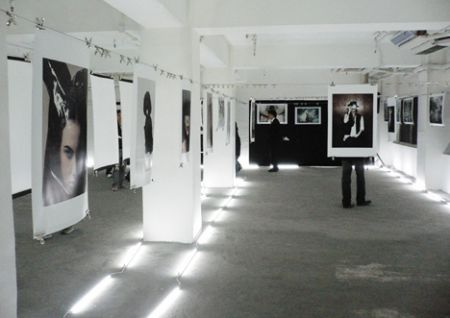
I found some references from a few artists who exhibited a little differently. First was a photographer from Hong Kong named JC who exhibited his photos by clipping them onto wires hung throughout the gallery.  Since I'm searching for a different approach to the exhibition process, I really enjoyed looking into his methods.


Becky showed me an artist named Lorna Simpson as well, who incorporates found photos in her works, as well as a collage-d way of exhibiting her works.  1957-2009 is a work I found particularly interesting - Simpson came across a set of old found photos of a model and a man.  She re-created the photos herself, and framed and hung everything together as one. All the photos are small and framed tightly together, inviting the viewers to come in and try to figure out which are the originals and which are the re-creations.


Simpson also exhibited some works that were framed as collages, incorporating found photos in her works, incorporated with ink drawings and plates of brass.


Simpson's ways of working and her exhibitions, as well as her incorporation of found photos in her work is really intriguing.  The appropriated photos make sense in her works.  It's something I can take into consideration when trying to figure out how to play found photos into my work.